
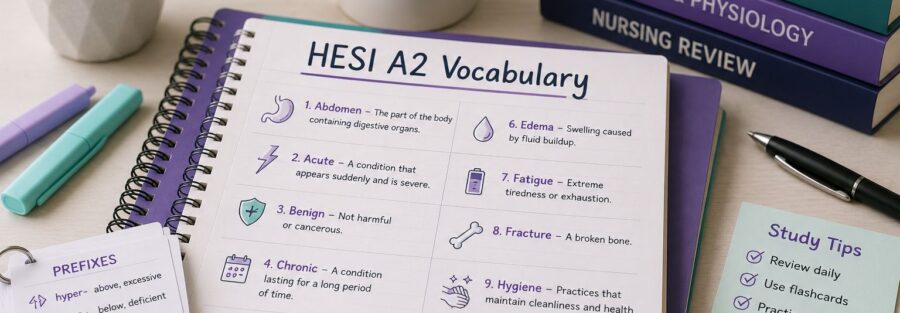
Preparing for the HESI A2 exam requires more than memorizing definitions. The Vocabulary and General Knowledge section tests a student’s ability to understand commonly used academic, medical, and nursing-related terminology.
A strong vocabulary can improve:
- reading comprehension
- grammar understanding
- exam confidence
- question interpretation
- overall HESI A2 performance
In this guide, we’ll review 50 important HESI A2 vocabulary words every future nursing student should know before exam day.
Why Vocabulary Matters on the HESI A2 Exam
Many HESI A2 questions include:
- medical terminology
- academic vocabulary
- context clues
- sentence interpretation
- grammar-related wording
Students who understand vocabulary are often able to:
- read faster
- understand questions more clearly
- avoid common mistakes
- improve confidence during the exam
Consistent vocabulary review can make a major difference in preparation.
50 Essential HESI A2 Vocabulary Words
1. Abdomen
The part of the body containing digestive organs.
2. Acute
A condition that appears suddenly and is severe.
3. Benign
Not harmful or cancerous.
4. Chronic
A condition lasting for a long period of time.
5. Diagnosis
Identification of a disease or condition.
6. Edema
Swelling caused by fluid buildup.
7. Fatigue
Extreme tiredness or exhaustion.
8. Fracture
A broken bone.
9. Hygiene
Practices that maintain cleanliness and health.
10. Infection
Invasion of harmful microorganisms in the body.
11. Inflammation
Redness, swelling, or irritation in body tissue.
12. Intravenous
Administered directly into a vein.
13. Malignant
Cancerous or harmful.
14. Metabolism
The body’s process of converting food into energy.
15. Nausea
A feeling of sickness or urge to vomit.
16. Nutrition
The process of obtaining nutrients from food.
17. Obesity
Excess body weight or fat accumulation.
18. Organism
A living thing such as bacteria or viruses.
19. Pathogen
A microorganism that causes disease.
20. Pulse
The rhythmic beating of arteries caused by heartbeats.
21. Respiration
The process of breathing.
22. Sterile
Free from bacteria or microorganisms.
23. Symptom
A sign or indication of a disease.
24. Therapy
Treatment intended to relieve or heal a condition.
25. Tissue
A group of cells performing a specific function.
26. Trauma
A serious injury or emotional shock.
27. Vital Signs
Measurements of body functions such as pulse and temperature.
28. Antibody
A protein that helps fight infection.
29. Artery
A blood vessel carrying blood away from the heart.
30. Cardiac
Related to the heart.
31. Circulation
Movement of blood through the body.
32. Dehydration
Loss of body fluids.
33. Epidemic
A widespread outbreak of disease.
34. Immune
Protected against disease.
35. Incision
A surgical cut made in the body.
36. Infection Control
Methods used to prevent the spread of disease.
37. Medication
A drug used to treat illness.
38. Observation
Careful monitoring of a patient’s condition.
39. Prognosis
Expected outcome of a disease or condition.
40. Rehabilitation
Therapy used to restore health or ability.
41. Sanitize
To clean and reduce germs.
42. Specimen
A sample collected for medical testing.
43. Surgical
Related to surgery.
44. Temperature
A measure of body heat.
45. Vein
A blood vessel carrying blood toward the heart.
46. Wellness
The state of good health.
47. Diagnosis
Medical identification of a disease or illness.
48. Anatomy
Study of body structure.
49. Physiology
Study of body functions.
50. Prescription
A written order for medication or treatment.
Best Ways to Study HESI A2 Vocabulary
Memorizing vocabulary becomes easier when students use active learning strategies.
Helpful methods include:
- flashcards
- spaced repetition
- vocabulary notebooks
- practice questions
- context-based learning
- daily review sessions
Instead of only memorizing definitions, try using words in sentences and connecting them to real nursing scenarios.
Focus on Medical Terminology
Many HESI A2 vocabulary questions involve:
- prefixes
- suffixes
- root words
Learning common medical word parts can help students understand unfamiliar terms more easily.
Examples:
- cardio = heart
- neuro = nerves
- derm = skin
- hypo = below
- hyper = above
Recognizing patterns improves vocabulary comprehension significantly.
Use Context Clues
During the exam, students may encounter unfamiliar words. Context clues can help identify meanings without knowing exact definitions.
Look for:
- surrounding words
- sentence tone
- examples
- comparisons
- opposites
Strong reading comprehension often improves vocabulary performance naturally.
Vocabulary preparation is an important part of HESI A2 success. Building familiarity with common nursing and medical terminology can improve reading speed, question interpretation, and overall exam confidence.
The key is consistency.
Review vocabulary regularly, practice actively, and focus on understanding how words are used within nursing and healthcare settings.
With structured preparation and the right study resources, future nursing students can approach the HESI A2 exam with greater confidence and readiness.
